Chasing Losses, 1Win Game
A practical guide to chasing losses for 1win game: the steps, the limits and the common mistakes.
What is chasing losses?
Chasing losses is the act of placing additional bets specifically to recover money lost in earlier rounds. On 1win game, it happens when a player shifts from playing a planned session to playing reactively, letting a bad result dictate the next bet rather than sticking to a pre-set strategy. It is one of the most documented and financially damaging patterns in online gaming, and it is more common on fast-cycle digital titles, crash games, instant slots, live roulette, than in any other format because results arrive every 10 to 30 seconds, compressing the time between loss and reactive decision.
The behaviour is distinct from normal continued play. The defining marker is motivation: you are no longer betting because the game is enjoyable or because conditions look favourable, you are betting because you lost. A player who loses ₹500, reviews their remaining bankroll, confirms they are within their session plan, and places a normal-sized next bet is not chasing. A player who loses ₹500 and immediately raises their stake to ₹1,000 specifically to recover that ₹500 in the next single round is chasing, regardless of whether that round wins or loses.
In the Indian online gaming context, the pattern is amplified by frictionless instant deposit infrastructure. With UPI-linked apps such as PhonePe, GPay, and BHIM, adding funds to a 1win game account takes under 30 seconds. There is no cooling-off built into the deposit process, a player who has just hit their session bankroll limit can top up before the emotional impulse fully registers. This is fundamentally different from walking to an ATM or waiting for a bank transfer to clear, both of which create natural pause points. The convenience that makes UPI excellent for everyday payments also removes a friction layer that historically protected players from reactive over-spending.
- Increased stake size: doubling or multiplying bet amounts after a losing round to "get it back in one hit." For example, a player running a ₹200-per-round session on a crash game raising to ₹800 after three consecutive early exits.
- Session extension: continuing past a pre-planned stop point because the session ended negatively. A player who planned a 45-minute session but is still active 90 minutes later specifically because they are behind.
- Game switching: jumping to a higher-volatility title on 1win game immediately after a loss, hoping for a faster recovery. Moving from a low-volatility slot to a high-volatility crash variant when chasing is particularly costly because the variance profile of the new game is least suited to a depleted bankroll.
- Deposit top-ups mid-loss-streak: adding funds via PhonePe, GPay, or BHIM specifically to keep chasing rather than walking away. This converts a session loss into a session-plus-additional-deposit loss, almost always at a worse overall rate than the original session was tracking.

Chasing losses step by step
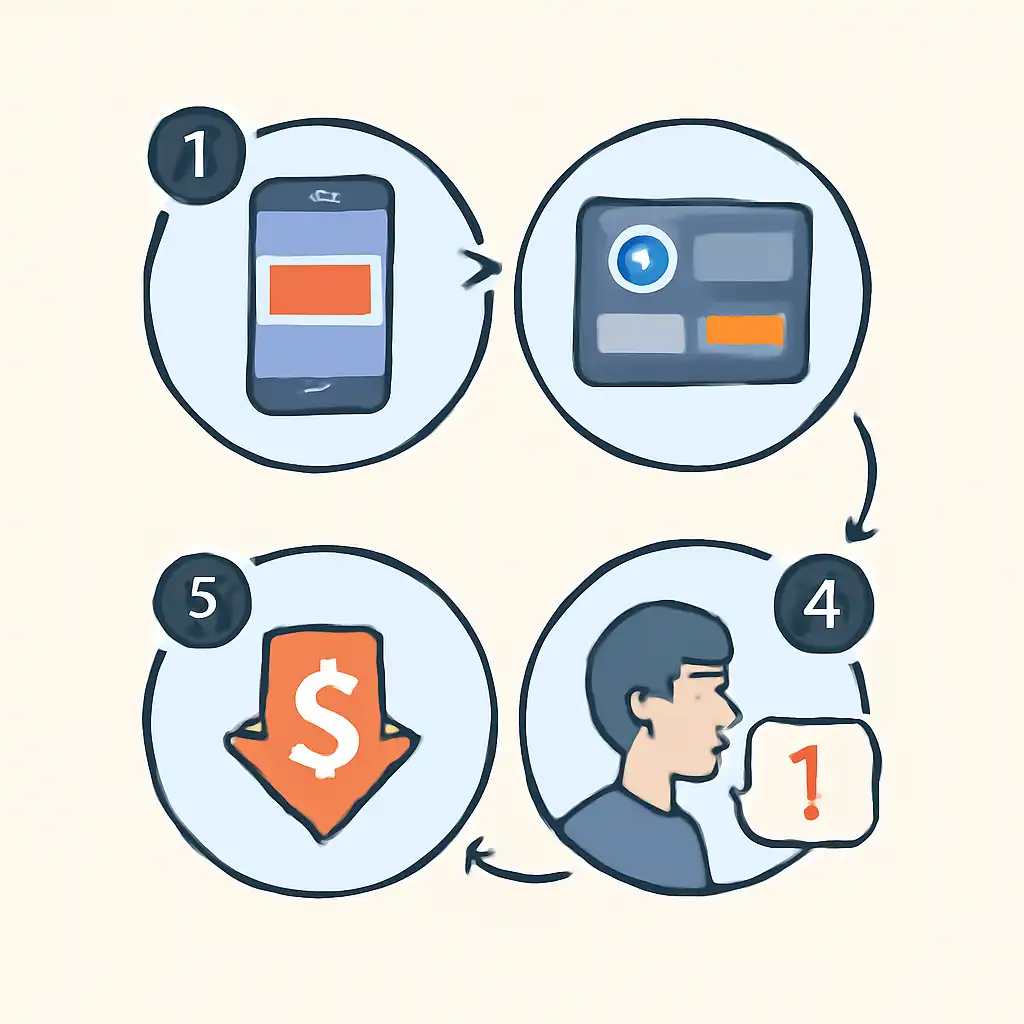
Chasing rarely arrives all at once. It unfolds in a predictable sequence that takes most players 3 to 7 minutes from trigger loss to first inflated stake. Mapping that sequence on 1win game helps you identify which stage you are in, and exit before it escalates. Each step below includes the internal narrative players typically experience, which makes the pattern easier to self-identify in real time.
-
Step 1, The trigger loss.
A single result wipes a meaningful portion of your session bankroll, typically 20% or more in a single round. On crash games this is often an early exit at 1.00× or 1.01× after setting a manual cash-out target of 3×; on slots it is a dead bonus round that paid less than the cost of triggering it. The loss feels unfair or premature rather than a normal variance event. Internally, players often describe this as "that shouldn't have happened", a signal that variance is being misread as injustice.
-
Step 2, The emotional recalculation.
You mentally reframe your remaining balance as "down ₹X" rather than "have ₹Y." A player who started with ₹2,000 and now has ₹1,400 stops thinking "I have ₹1,400 to play with" and starts thinking "I am ₹600 down." That framing shift is critical: it makes continuing feel like recovery rather than fresh risk. This is where chasing technically begins, even before the next bet is placed. The player's goal has changed from "play a good session" to "erase this deficit," and every subsequent decision will be filtered through that new goal.
-
Step 3, The inflated stake.
Your next bet on 1win game is larger than your session average, often 2× to 5× the typical stake, because a normal-sized win would not close the perceived gap fast enough. A player running ₹100 rounds who is ₹600 down knows that a single ₹100 win at standard odds only returns ₹100 profit, not enough to feel like recovery. So the stake climbs to ₹300 or ₹600.
But here the maths turn hostile: the same percentage swing that produced a small win at ₹100 now produces a loss 3 to 6 times larger. One losing round at the inflated stake can deepen the deficit more than the original trigger loss did.
-
Step 4, The compounding decision point.
If the inflated stake also loses, you face a fork: accept a larger total loss and stop, or raise stakes again. Most players who reach this point raise again, the emotional investment in recovery has grown proportionally with the additional loss, making stopping feel like compounding the failure rather than limiting it. Each repetition compresses your remaining bankroll and shortens decision time under stress. A player who started a ₹2,000 session and has now lost ₹1,200 across three escalating stakes has less than 35 minutes of play time left at their original ₹100 stake, creating urgency that further degrades judgment.
-
Step 5, The mid-session top-up via UPI.
When the session bankroll is nearly exhausted but the chasing impulse is still active, many players in India top up instantly using PhonePe or GPay, often in ₹500 or ₹1,000 increments. Unlike a process that requires re-entering card details, a saved UPI PIN transaction completes in under 15 seconds. The deposit arrives before the emotional decision has time to surface as doubt. This step converts a contained session loss into an open-ended one, and because the top-up feels smaller than the cumulative loss already absorbed, it rarely triggers the same hesitation the original session deposit did.
-
Step 6, The hard stop (forced or chosen).
The session ends either because funds run out again, a deposit limit set in the 1win game account activates, or exhaustion forces a natural exit. Chasing sessions almost universally end at a larger deficit than the original trigger loss that started the cycle, often 3× to 8× that initial amount, because each escalation was sized to recover all previous losses in a single win rather than incrementally.
How chasing losses works
Chasing losses on 1win game is not simply irrational, it is driven by specific psychological and mathematical mechanics that make the behaviour feel logical in the moment. Understanding each mechanism separately makes it possible to counter them with a concrete rule rather than just willpower.
The maths that make recovery feel close
After a 50% drawdown, players need a 100% gain to return to even, not 50%. Most players dramatically underestimate this asymmetry. Concrete example: a player starts with ₹2,000, loses ₹1,000, and now has ₹1,000. To return to ₹2,000 they need to double their remaining stack. At a 96% RTP slot with a 4% house edge, the expected return on that ₹1,000 is ₹960, meaning the maths push them further from break-even with every additional round played, not toward it.
A ₹1,000 loss at a 2× bet feels recoverable in one round, but the actual probability of hitting that exact return depends entirely on the game's RTP and variance, not on how much you need to win.
Loss aversion and the pain of staying still
Behavioural research consistently shows that losses feel roughly 2.25 times as painful as equivalent gains feel pleasurable. On 1win game, this means a ₹500 loss creates an emotional weight comparable to missing a ₹1,125 win. To escape that pain, the brain pushes toward action, another bet, because action feels like control and inaction feels like permanently accepting defeat. Sitting still with a ₹500 loss is, neurologically, almost as uncomfortable as experiencing that loss for the first time, which makes "just one more round" feel like the obvious response even when a rational audit of the session would recommend stopping.
The gambler's fallacy on live games
Crash games, roulette, and RNG slots on 1win game all produce statistically independent outcomes. A run of low crash multipliers, five consecutive exits below 1.5×, does not make the next multiplier statistically more likely to be high. The RNG resets completely between rounds. But the pattern-seeking human brain reads sequences as meaningful, turning a neutral distribution into what feels like "the game owes me a big round." This belief is testable and false: if you charted 10,000 crash rounds, you would find that a sequence of five sub-1.5× exits is followed by a high multiplier at exactly the same base rate as any other sequence.
The game does not accumulate debt. Each round resets.
Volatility as accelerant
High-volatility slots and crash variants amplify chasing more than low-volatility alternatives. A low-volatility game returns value steadily and predictably, keeping session swings narrow. A high-volatility game with the same 96% RTP distributes that return in rare, large clusters with long dry periods in between. Chasing on high-volatility 1win game titles increases the chance of hitting the long losing-streak portion of the distribution without the bankroll left to survive into the recovery spike.

Compared to chasing on a low-volatility title, where a modest inflated stake has a reasonable chance of a small recovery win, chasing on high-volatility games is statistically far more likely to result in a total bankroll wipeout before the rare big win arrives.
UPI instant deposits as structural enabler
In the Indian market specifically, the combination of loss-aversion psychology and frictionless UPI infrastructure creates a unique risk profile. When a player using PhonePe or GPay exhausts their session bankroll mid-chase, the re-deposit decision takes less time than it would take to get up from a chair at a physical venue. BHIM-linked accounts with saved UPI handles complete transactions in 8 to 15 seconds with a single PIN entry. This removes the final natural circuit-breaker in the chasing cycle, the moment of physical effort and time delay that historically allowed emotional temperature to drop before more funds were committed.
The practical counter-strategy is to remove saved UPI shortcuts from the 1win game deposit screen before starting any session, forcing that extra 60 seconds of re-entry that functions as a reset point.